How to Extract Nutrients From Birch Bark in Survival Scenarios
You can get nutrients from birch bark by harvesting only the inner cambium layer without girdling the tree. Peel it in spring when it lifts easily, then remove the outer bark and dry the tan inner layer fast to preserve nutrients. Grind it into powder once brittle, and mix with water or food to aid digestion. Eating it raw risks irritation, so always process it first. Stick to healthy trees in clean areas to avoid toxins. Mistaking lookalikes could be dangerous, so confirming the right tree matters just as much as the method. You’ll want to know how timing and tools affect yield and safety.
Notable Insights
- Identify paper or yellow birch trees in cool climates and harvest only loose outer bark to avoid killing the tree.
- Peel back the outer bark to access the nutrient-rich inner cambium layer, which is tan and soft.
- Remove the inner bark carefully, ensuring no contamination from debris, dark spots, or damaged areas.
- Dry the inner bark quickly in sunlight or near heat until brittle to preserve nutrients and ease processing.
- Grind dried inner bark into fine powder and mix with water or food for safe, digestible nutrient intake.
Identify Birch Bark in the Wild
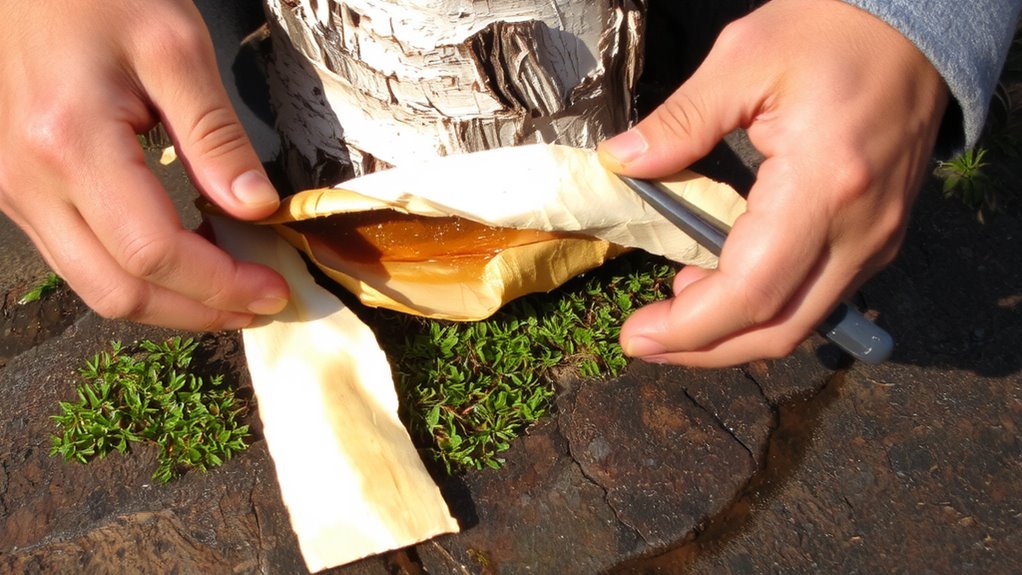
Birch bark stands out in northern forests by its color and texture-look for the pale, peeling layers on trees that grow in cool climates across North America, Europe, and Asia. You’ll recognize it by the smooth, papery bark texture that curls away from the trunk in thin sheets. This trait makes tree identification simple when you’re in mixed woodlands. Paper birch has bright white bark, while yellow birch leans bronze and has tighter curls. Don’t confuse it with aspen, which has darker, less flaky bark. Proper bark texture helps you confirm species quickly under stress. Moisture can make it appear darker, so peel a small layer to check the inner bark color and consistency. You’re aiming for tight, light-colored layers with a faint wintergreen scent when crushed. Getting the right tree matters-only true birch offers the nutrients and water resistance useful in survival. Misidentification wastes time and effort.
Harvest Bark Without Harming the Tree
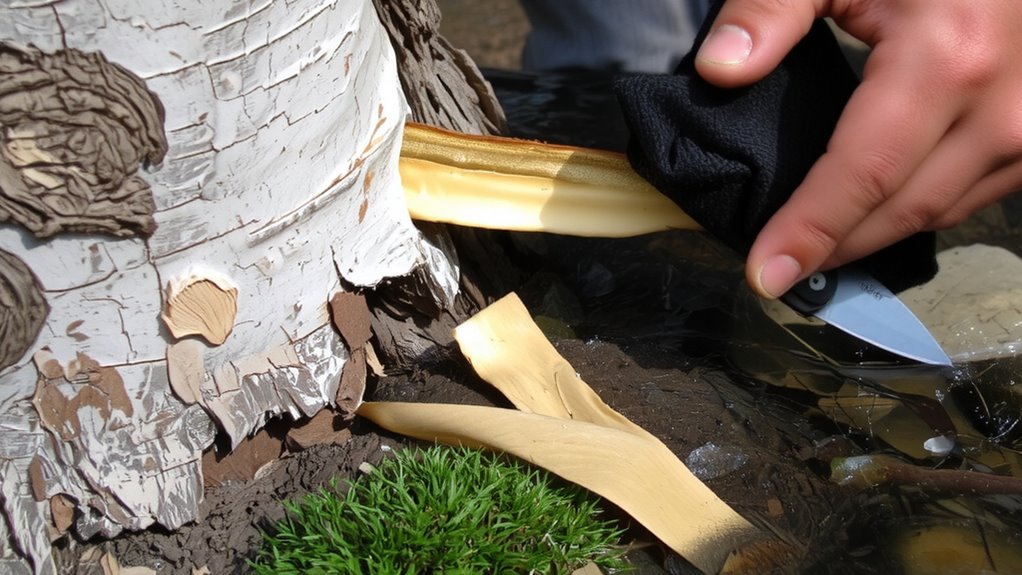
You can harvest bark sustainably by taking only what the tree can spare-never remove a complete ring around the trunk, as that kills the tree by severing its nutrient flow. Practice ethical foraging by targeting loose outer layers from healthy birch trees, especially in spring when the bark separates easily. Use a knife to lift a section, then peel carefully without gouging the cambium. Sustainable harvesting guarantees the tree survives and continues to provide resources.
| Tool | Purpose |
|---|---|
| Fixed-blade knife | Control and precision in cuts |
| Gloves | Protect hands from splinters |
| Shears | Trim smaller bark pieces |
| Notch test | Check if bark lifts easily |
Take only what you need. Damage beyond repair undermines ethical foraging principles.
Prepare the Inner Bark for Survival Use
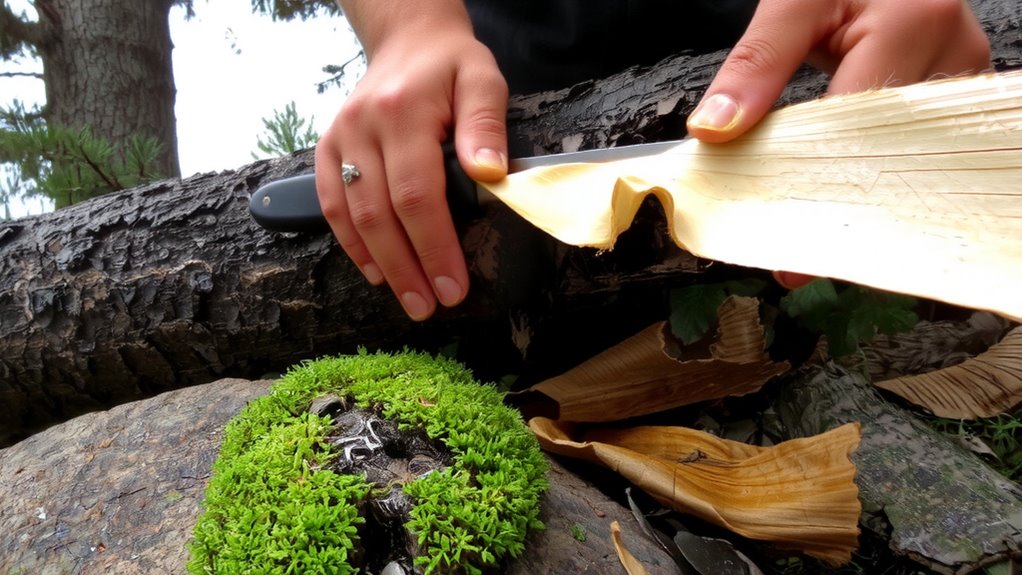
Once you’ve harvested the bark, focus on accessing the inner layer, since that’s where the nutrients are concentrated. Use a knife or your fingers to separate the papery outer bark from the softer, tan-colored inner layer. This inner bark, or cambium, is key for nutrient extraction and should be cleaned of any debris or dark spots. Remove only what you need-excess handling reduces shelf life. You’re preparing raw material for survival preparation, so efficiency matters. Work quickly but carefully to preserve moisture and nutrients. Keep the inner bark sections whole for now; slicing too early increases surface area and risk of contamination. The goal is effective nutrient extraction later, so avoid crushing or bruising the tissue. Every step here directly affects usability in a real survival situation. Stay focused on function-this isn’t about convenience, it’s about staying alive.
Dry and Grind Birch Bark Quickly
A few hours of drying time is all you’ve got before moisture loss begins degrading nutrient integrity, so act fast. Spread thin strips of inner bark in a single layer near a heat source or in direct sun. Rotate every 30 minutes to guarantee even drying-this maximizes time efficiency. Once brittle, grinding becomes far easier. Tool selection matters: harder stones or metal edges crush fibers more effectively than soft rocks.
| Method | Drying Time (Approx.) |
|---|---|
| Direct Sunlight | 3–4 hours |
| Near Fire | 1–2 hours |
| Air Drying | 6+ hours |
| Reflective Heat | 2–3 hours |
| Wind Exposure | 4–5 hours |
Use minimal force with sharp tools to conserve energy. Coarse powder works-precision isn’t critical. Proper tool selection and focus on time efficiency preserve nutrients and boost yield.
How to Eat Birch Bark Safely
While raw birch bark isn’t digestible and can irritate the digestive tract, properly processed inner bark is safe to consume in moderation. You must first separate the inner bark from the outer, then dry and grind it into a fine powder for effective nutrient extraction. This method breaks down tough fibers, making carbohydrates and trace nutrients accessible. Consuming the powder mixed with water or added to other foods supports safe consumption by reducing strain on your digestive system. Don’t eat large quantities-your body can only process so much at once. Overconsumption may cause bloating or discomfort, even with proper preparation. The inner bark provides minimal calories and nutrients compared to other survival foods, so use it as a supplement, not a primary source. Processing time and energy should justify the return; otherwise, the trade-off isn’t worth it. Always prioritize known edible plants when available.
When Birch Bark Isn’t Safe
Don’t assume processing removes all risks-birch bark can still be unsafe even when prepared correctly. Contamination risks exist if the tree grows near polluted areas, such as roadsides or industrial sites, where bark absorbs heavy metals or chemicals. You can’t taste or smell these toxins, so location matters as much as preparation. Also, misidentifying the tree introduces serious danger. Toxic lookalikes, like yellow birch with high levels of methyl salicylate or other bark-bearing trees such as poison sumac, can cause illness or worse. Always verify the tree’s papery, layered bark and wintergreen scent when scratched-typical of white birch. If the bark peels in thin, translucent sheets and you’re certain of the species, proceed cautiously. Even then, limit consumption over time to reduce potential side effects. When in doubt, skip it-your survival depends on accurate, cautious decisions, not desperation.
On a final note
You can rely on birch bark in a survival situation, but only if processed correctly. Harvest sparingly from live trees, focusing on loose outer layers. Use the inner bark, dry it thoroughly, and grind it fine to improve digestibility. Eat in small amounts to avoid stomach issues. It’s low in nutrients compared to other survival foods, so combine it with better sources when possible. Don’t risk it if mold or discoloration is present.