How to Prioritize Care Using the ABCDE Approach in a Multi-Casualty Incident
You start with airway and breathing-clear obstructions fast, since oxygen loss causes brain damage within minutes. Then control severe bleeding with direct pressure or a tourniquet above the wound, not over joints. Check responsiveness and pupils to spot brain injury early. Fully expose the patient to find hidden trauma, cutting clothes if needed. Reassess ABCDE every few minutes-conditions change fast. Team coordination keeps monitoring sharp and treatment effective under pressure. Details matter when seconds count.
Notable Insights
- Prioritize airway management first, ensuring patency with head-tilt/chin-lift or jaw-thrust if trauma is suspected.
- Address breathing immediately by checking for effective respiration and treating life-threatening conditions like tension pneumothorax.
- Control severe hemorrhage promptly using direct pressure, wound packing, or tourniquets on limbs to prevent exsanguination.
- Assess responsiveness and neurological status rapidly using the Glasgow Coma Scale and pupil reaction to identify critical brain injury.
- Fully expose patients to locate hidden injuries while maintaining warmth and dignity, then continuously reassess ABCDE in evolving scenarios.
ABCDE Step 1: Clear the Airway and Check Breathing
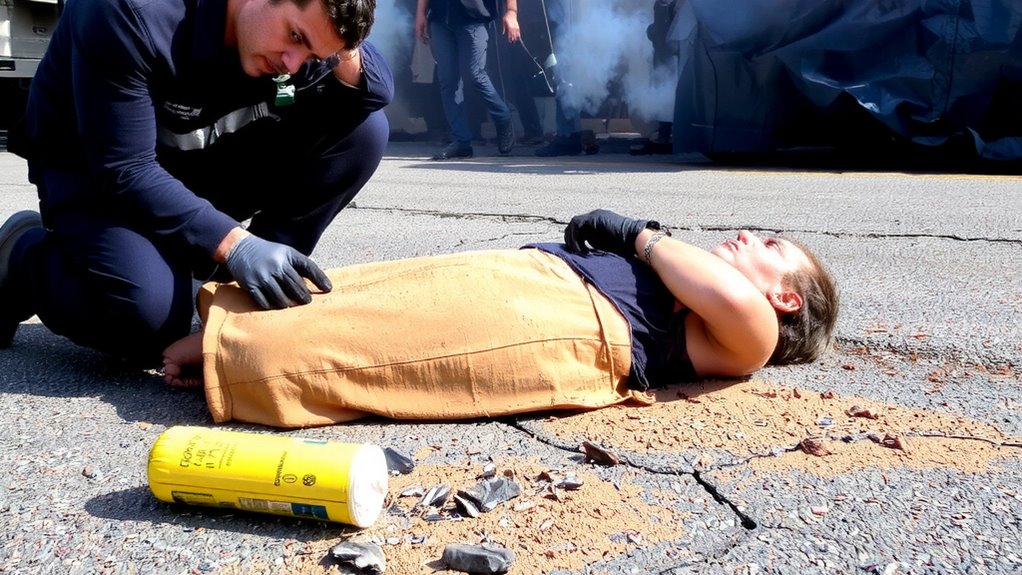
If you’re evaluating a patient in distress, start by checking the airway-any obstruction cuts off oxygen, and without oxygen, brain damage begins in minutes. An airway obstruction might be partial or complete; if the person can’t speak or make sounds, assume it’s severe. Look for signs like stridor, gurgling, or nasal flaring. Open the airway using a head-tilt/chin-lift or jaw-thrust if trauma’s suspected. Clear visible debris with a finger sweep, but don’t blind probe. Then assess breathing. Breathing difficulty presents as rapid, shallow breaths or use of accessory muscles. Check chest rise and listen for breath sounds. Gasping isn’t effective breathing. If absent or inadequate, prepare to ventilate. You’ve got seconds, not minutes. A pulse might persist briefly without breathing, but not for long. Address airway obstruction and breathing difficulty in that order-they’re immediate threats to survival. Every second counts.
ABCDE Step 2: Stop Severe Bleeding Fast
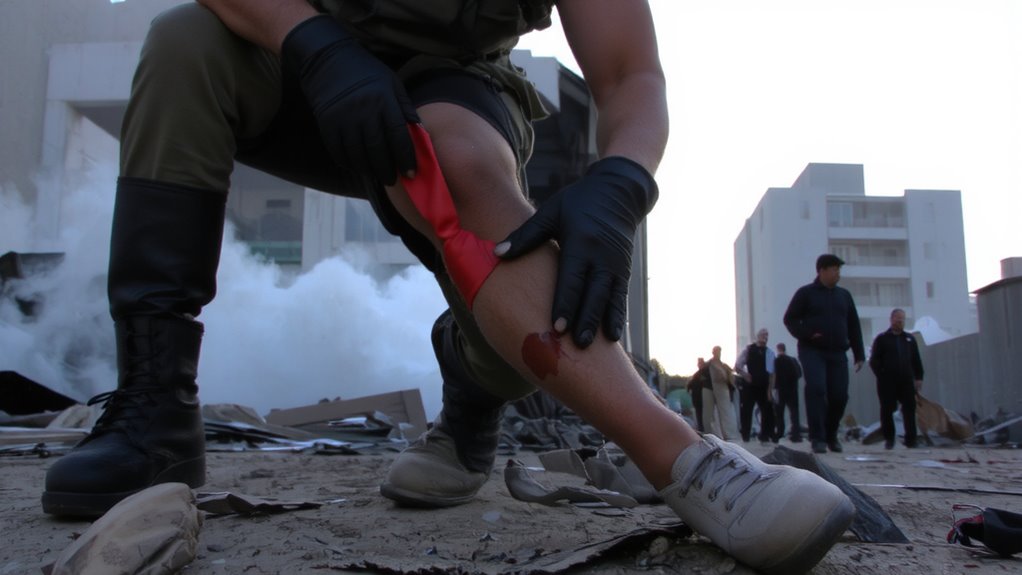
You tackle severe bleeding immediately after securing the airway and breathing-because massive blood loss drops blood pressure fast, cutting oxygen to essential organs. Hemorrhage control is non-negotiable; uncontrolled bleeding kills in minutes. You act fast: expose the wound, apply direct pressure, and pack it if deep. For limb injuries with life-threatening bleeding, tourniquet application is the standard. Use a wide-band tourniquet (at least 1.5 inches wide) to avoid nerve damage. Place it 2–3 inches above the wound-never over a joint. Tighten until bleeding stops. Record the time of application. Commercial tourniquets like the CAT or SOF-T are reliable, with consistent performance in field tests. Improvised versions often fail under stress. You don’t wait for medical backup-delay means death. Effective hemorrhage control doubles survival chances in tactical and civilian settings alike. You do it right, or it won’t work. Among the most trusted options, best tourniquets combine durability, ease of use, and proven efficacy in high-pressure scenarios.
ABCDE Step 3: Assess Responsiveness and Neuro Status
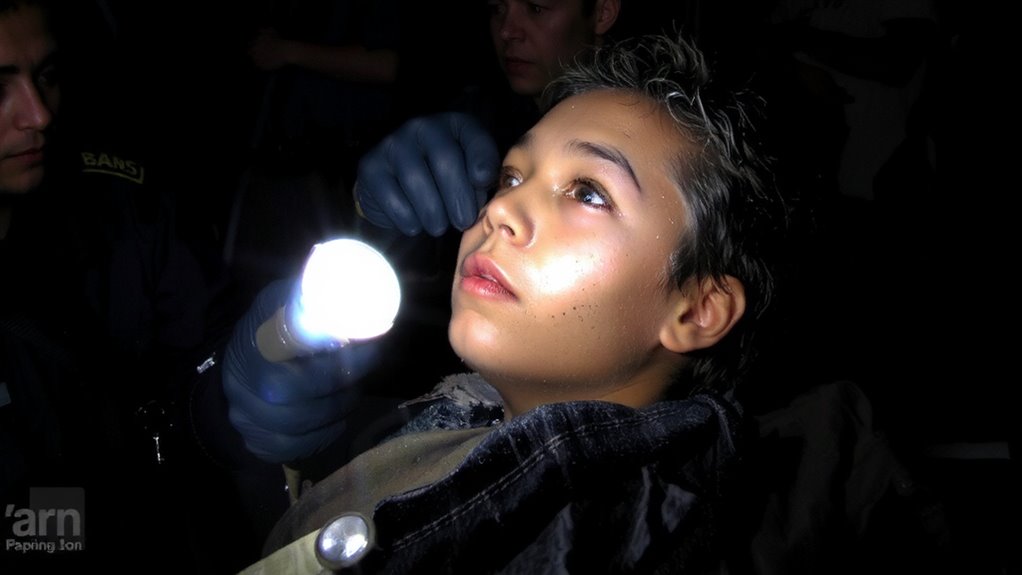
A quick check of responsiveness gives the first clue to brain function and guides the urgency of your next moves. You shout, “Are you okay?” while gently shaking the person. If they respond, they’re likely neurologically intact enough to follow simple commands. If not, you assess eye opening, verbal response, and motor movement-this forms the Glasgow score. A score below 8 means severe impairment and high risk; they need immediate attention. You also check pupil reaction using a penlight. Both pupils should constrict equally. Sluggish or unequal response suggests brain injury. Don’t spend more than 30 seconds on this. Pupil reaction and Glasgow score together tell you how compromised the nervous system is. You use this data to prioritize who gets evacuated first. Accuracy here beats speed-misreading neuro status leads to wrong triage decisions. Stay focused, stay objective.
ABCDE Step 4: Fully Expose for Hidden Injuries
One full exposure can reveal what’s missed in the chaos-unseen bleeds, fractures, or burns hidden under clothes. You need to strip the patient carefully, but quickly, balancing speed with patient dignity. Work in teams: one cuts clothing while another covers exposed areas not being assessed. Protect against environmental hazards like rain, cold, or sun-exposure increases hypothermia and shock risks. Use blankets or tarpaulins to maintain modesty and warmth. Never leave the patient fully uncovered. Including a high-quality survival tool in your medical kit can aid in cutting clothing efficiently while minimizing patient movement.
| Action | Purpose |
|---|---|
| Cut clothes symmetrically | Guarantees quick removal without moving the patient |
| Cover immediately after inspection | Preserves patient dignity and prevents heat loss |
Expose fully, but respect the person. Your actions must be deliberate-every second counts, but so does humane care.
ABCDE Step 5: Reassess Continuously in Chaos
How often does a patient’s condition change without warning? In mass casualties, it happens constantly. That’s why you must reassess continuously-every few minutes if unstable. You can’t rely on a single ABCDE assessment. Airway patency, breathing effort, circulation status-all can deteriorate rapidly. Team coordination guarantees someone is always monitoring while others intervene. Clear communication lets you shift resource allocation in real time, directing help where it’s needed most. Recheck each step: look for absent breath sounds, falling oxygen levels, rising heart rate. Expose and inspect again-hidden bleeding worsens silently. Reassessing isn’t extra work; it’s essential for survival. You adapt treatment based on current findings, not initial assumptions. In chaos, priorities shift. Only ongoing evaluation lets you catch changes early. Good resource allocation depends on up-to-date data. Team coordination keeps reassessment systematic, not random. You stay ahead by checking, not guessing.
On a final note
You’ve checked the airway, controlled major bleeding, and confirmed responsiveness-now keep reassessing. The ABCDE approach works in chaos because it’s structured and fast, not perfect but reliable. Expose injuries without wasting time; repeat steps as conditions shift. It won’t catch everything, but it prioritizes survival-critical issues. Simplicity is its strength-no gear needed, just consistent action. In mass casualties, that clarity saves lives.