Adapting Your Shelter Design to Varying Ground Conditions: Strategies for Building on Sandy, Rocky, or Mud-Laden Terrain
You need deep pilings in sand to reach stable layers, or your shelter will shift. On rock, use natural ledges as anchors-save time and gain strength. In mud, go high with reinforced platforms or floating slabs on pilings. Match foundations to soil: deep piers for sand, shallow footings on solid rock, elevated designs in wet ground. Drainage matters-use gravel trenches, swales, or French drains. Reinforced concrete and laminated framing handle stress better. Choose right, and your shelter stays put-you’ll see how each detail makes a difference.
Notable Insights
- Use deep pilings in sandy soils to anchor structures in stable strata and prevent shifting from loose grains.
- Integrate natural bedrock features as structural supports to minimize excavation and enhance stability without blasting.
- Employ floating or reinforced foundations on mud-laden terrain to prevent sinking and accommodate ground movement.
- Conduct soil testing to determine bearing capacity and select appropriate foundation types like piles, mats, or grade beams.
- Install drainage solutions such as French drains, gravel trenches, or sloped swales to manage water and reduce foundation stress.
Building On Sand: Anchor Deep, Drain Well
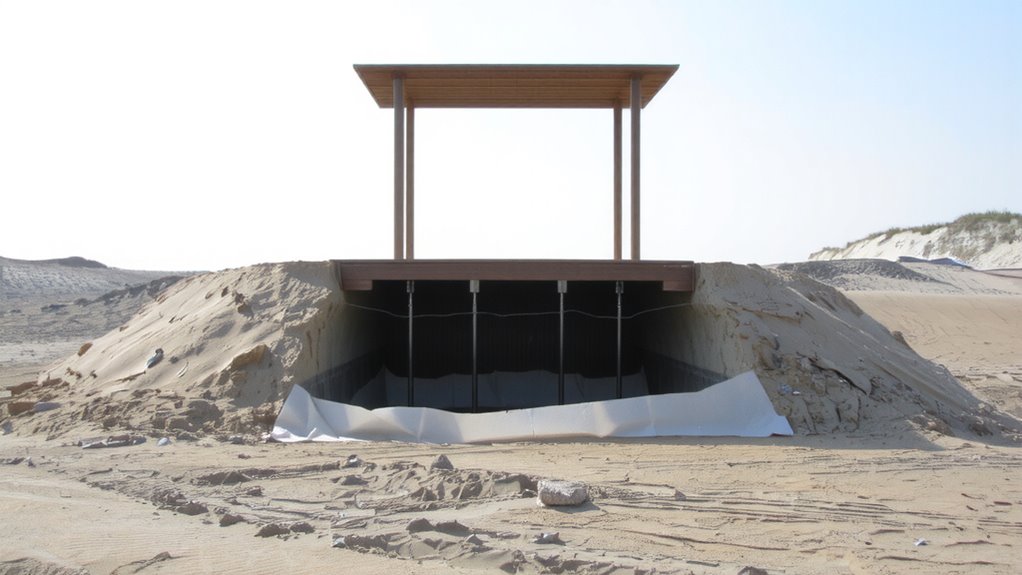
When you’re building on sand, stability starts with how deep your anchors go-shallow footings shift as the loose grains beneath them move, so you’ll need pilings driven at least 6 to 8 feet down to reach more competent strata. Sand compaction varies by site, so pre-loading or mechanical stabilization may be required to minimize settlement. You can’t ignore wind erosion-exposed sites lose sand quickly, undermining foundations over time. Build up berms or use windbreaks to slow the loss. Drainage is critical; sand doesn’t hold water but moves it laterally, so French drains or graded slopes help redirect flow. Avoid concrete slabs without proper reinforcement-they’ll crack under differential movement. Instead, use helical piers or driven piles with proven load ratings. These measures trade higher upfront cost for long-term stability. Test soil density before and after compaction to verify support capacity. In high-wind zones, combine deep anchoring with erosion controls-relying on one alone fails.
Don’t Fight The Rock: Build With It
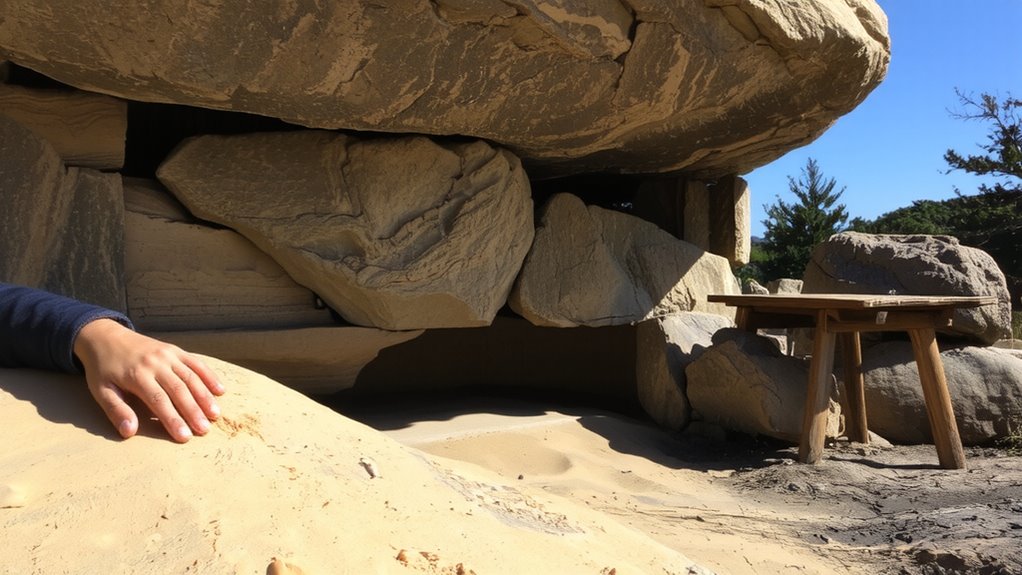
Though bedrock might seem like the ideal foundation, blasting or cutting into it adds cost and complexity you can often avoid by working with its natural shape instead of against it. Rock integration isn’t just practical-it’s efficient. You can anchor your shelter directly to stable ledges or use large boulders as part of your walls, reducing material needs. These features offer natural support, minimizing structural framing and increasing stability. Flat rock surfaces allow for secure placement of beams or posts without deep excavation. Irregular surfaces can be adapted with adjustable supports or leveled pads. Tests show shelters built with rock integration withstand wind loads better than those set on loose soil. You also lower long-term erosion risks. The trade-off? Slightly longer planning time to map contours accurately. But the payoff-less labor, fewer materials, and better durability-makes it worth it. Use the rock, don’t fight it.
Elevate Shelters Over Mud: Float Or Reinforce
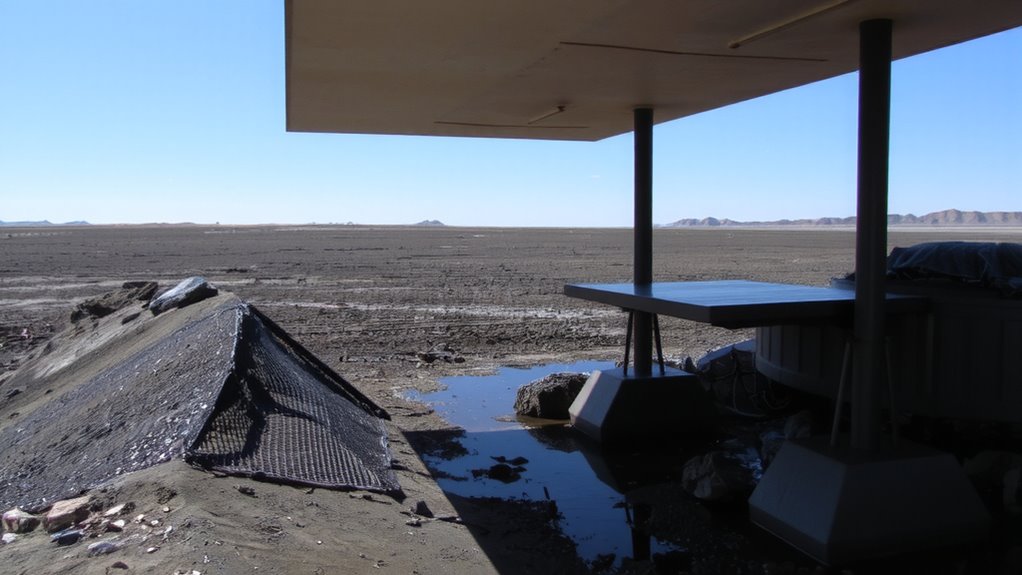
If you’re building where the ground stays saturated, sinking won’t be an option-elevating your shelter is the only way to maintain structural integrity. You’ll need to either float or reinforce. Floating foundations work by distributing weight across buoyant materials like sealed drums or foam blocks beneath a rigid frame. They adjust with water level changes but require secure anchoring to prevent drift. Reinforced platforms, in contrast, use treated wood or steel beams supported by driven pilings. They’re more stable long-term and handle heavier loads but cost more and take longer to install. Floating foundations suit temporary or flood-prone sites where water rises seasonally. Reinforced platforms are better for permanent shelters on consistently soft ground. Neither option resists lateral force well without additional bracing. Choose based on your load, site duration, and expected water movement. Both keep your floor dry when the soil can’t support direct contact.
Pick The Right Foundation For Your Soil
Your soil type decides which foundation will hold up over time, so match the design to what’s underfoot. Sandy soils shift easily, so you’ll need deep piers or pile foundations to anchor down to stable layers and improve load distribution. For rocky ground, shallow foundations often work since bedrock provides solid support, but you must account for uneven surfaces that can compromise contact. Mud-laden terrain demands raised or floating slabs, as discussed earlier. Always start with soil testing-it reveals bearing capacity and moisture levels that guide your choice. A spread footing may suffice on stable ground, but poor soils need reinforcements like grade beams or mats. Improper load distribution leads to settling or cracking, especially in variable terrain. There’s no universal fix-each solution trades cost, effort, and longevity. Pick based on test results, not assumptions. Your shelter’s stability depends on it.
Drain Water By Soil Type
How do you keep water from undermining your shelter’s foundation? You match your drainage strategy to soil permeability. Sandy soil drains fast-low water retention-but can shift under load. Use gravel trenches to direct flow away, preventing erosion. Rocky ground has high permeability where cracks allow seepage, but sheet runoff can pool at surface breaks. Install sloped swales to guide water around, not into, the foundation. Mud-laden soil has poor permeability and high water retention, swelling when wet, shrinking when dry. That movement risks structural stress. Here, French drains with perforated pipes and coarse stone help pull water away. You don’t rely on soil to absorb runoff-you manage it. Each soil type demands specific redirection: sand needs containment, rock needs channeling, and mud needs active dewatering. Drainage isn’t one-size-fits-all. Your shelter stays intact when you route water according to what’s underfoot.
Use Materials That Resist Ground Stress
Managing water is only half the battle-what supports your shelter when the ground shifts matters just as much. You need materials that handle compression, tension, and shifting loads without failing. Concrete reinforcement with rebar or fiber mesh increases tensile strength by up to 30%, preventing cracks in foundations on unstable soil. It’s not optional if you’re on sand or mud-prone sites where settling occurs. Pair that with stress resistant framing using laminated wood or steel trusses, which maintain integrity under uneven loads better than standard lumber. These frames distribute weight efficiently and resist warping under prolonged stress. On rocky terrain, anchored steel posts reduce flex, while in soft soil, deeper pilings with reinforced concrete minimize movement. You’re not just building upward-you’re anchoring against hidden forces. Test setups show reinforced concrete and engineered frames reduce structural failure by over 60% in high-stress conditions. Choose them to stay secure when the ground doesn’t.
Design For Your Terrain: Shelter Stability By Soil
Stability starts with soil-what’s underfoot determines how your shelter stands. If you’re on sand, deeper pilings anchor against shifting, but they won’t stop soil erosion if water moves through. You need wider bases to distribute weight and reduce sinking. Rocky ground offers firm support, yet drilling is tough; use adjustable footings to handle uneven surfaces. In mud, opt for helical piers-they reach stable layers beneath soft topsoil. Elevated designs help, but they increase wind exposure, so lower profiles win in open areas. Soil erosion demands runoff control: slope grading and gravel layers divert water. Concrete footers outlast wood in wet zones. Metal frames resist shifting better than plastic. Match materials and depth to soil type-compromises risk collapse. No foundation fixes poor assessment-test load capacity before committing. Your shelter’s life depends on what’s beneath it.
On a final note
You’ll need deeper anchors in sand to prevent shifting, and proper drainage keeps water from undermining your base. On rock, build around formations-excavation costs time and tools. Mud demands elevation or reinforced foundations to avoid sinking. Match materials to soil stress: treated wood resists rot, steel offers strength. Drainage angles matter-2% slopes move water reliably. No single fix works everywhere; test stability with load and weather exposure first. Choose simplicity, verify support.